Dave's Energy

Thursday, March 29, 2012

Switching from Coal to Natural Gas: Will It Impact Natural Gas Prices Near Term?

With historically low natural gas prices today, the argument continues to go that low prices will self-correct. My prior post "Explaining the Disparity Between Oil and Natural Gas Prices" discussed the supply side of things and why gas prices won't rise simply due to price-based changes in supply.

Most industry professionals and natural gas producers will tell you that they themselves only see prices rising once we have a significant demand response to low prices. My prior post discussed some of the reasons that fuel switching was no longer as big a deal as it may have been historically. But the main long-term demand response (fuel switching) that can, and will occur, is the displacement of coal fired electric generation capacity with natural gas fired capacity. This is nothing new. It was the standard future view back in the late 1990's early 2000's when gas was last at this low price range of $2-$3/MCF (mmbtu). But, when gas demand outpaced supply, prices went up in the 2003-2008 period and the conversations all started to shift to renewable energy (solar, wind). Now with low gas prices and ample supply we are again back to gas as a "bridge" (albeit a long one) to a more renewable future. The question then becomes whether switching to gas from coal will have a significant near-term 1-3 year impact on natural gas prices. I will contend the answer is no.

First note that moving to gas from coal is not really "fuel switching" - that is, the power producer doesn't just change the fuel in the plant, they build a new natural gas plant and retire or reduce the use of the old coal plant. For this reason, it doesn't happen quickly and therefore doesn't have a rapid-demand-response impact on pricing.

So let's take a look at how much additional gas demand might come from the current plans for building new plants and how much might come with a big push to retire old coal plants.

First off, here is a chart that shows the existing electric generation capacity in the United States, by fuel type. All data is from the Energy Information Administration (www.eia.gov):


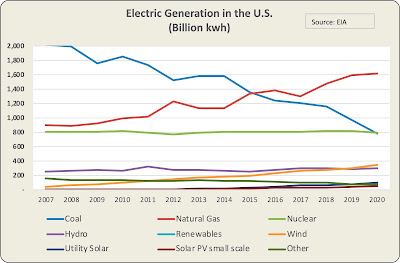
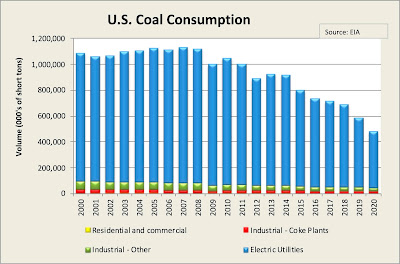
Note that although we have more natural gas capacity than coal, we generate more electricity from coal (see chart below), because those plants are typically "base-load" capacity (run continuously) while many gas plants are used to generate peak power(intermittently turned on to meet peak power needs). The chart below also shows the historic rise in natural gas as part of our mix, and the drop off in coal during the most recent economic downturn. Natural gas has increased through both high and low price environments, because it is a better fuel (cleaner, more efficient). With low prices for the foreseeable future, that market share increase can improve even more. And with potential carbon legislation, gas will be significantly favored over carbon-heavy coal.


Now here is a table showing all the planned electric generation capacity additions (as of Nov 2011) through 2015:


Based on the planned additions, the electric generation mix is not expected to change much through 2015. Natural gas will add 37,718,000 MW of capacity, which is 8.1% growth over the existing 467,214,000 MW of existing capacity. Coal grows 2% while wind grows 39% and solar would grow a whopping 840%. When all is done, however, solar is still less than one percent of all generation, and natural gas only moves from 41% to 41.5% while coal drops from 30.1% to 29%.


So how much more natural gas demand might come from that 8.1% increase in capacity? Well, existing gas demand in 2011 for electric generation was 7,600 Trillion Cubic feet (TCF), or approximately 20.8 BCF per day. Simply, let's assume an 8.1% increase to that, and we'd be using an additional 1.6 BCF per day by 2015. The number would likely be higher, because the new capacity may be more fully utilized than existing capacity, which includes a lot of "peak" plants. So let's assume a number more like 3 BCF per day additional demand from electric generation. That's a meaningful amount of gas, but compare that number to the continued growth in production as discussed in my prior post:


You can see that 3 BCF of additional demand isn't going to make enough of a difference, given that we are producing 10 BCF more each day than we were just a few years ago.

The holy grail of changes to gas demand would come from retiring much of our aging coal plants infrastructure with gas plants. Below is a "heat map" from Platt's (McGraw-Hill) showing that much of our existing coal capacity is from plants over 40 years old.


If we retired a quarter of the oldest plants in the U.S., and replaced them with gas at a level that represented about 10% of our electricity mix, that would likely increase gas demand by an aggregate of close to 10 BCF. That would have a meaningful impact on gas prices, and would generate a significant improvement in our emissions profile. But even with a move up in prices, let's say back to a normalized $6/MCF, gas prices are still attractive to the power generator(demand). They also then become more attractive to the gas producer (supply), and we would see even more supply being developed. So we shouldn't fear higher gas prices...that is what would make the move to natural gas a sustainable one.

How soon can we make a move like this? I contend not in the 1-3 year time frame. But to some extent that is dependent upon how much of the excess gas plant "peaker" capacity could be re-purposed for baseline usage and how much new capacity would have to get built - starting right now.

Labels: , , , , , ,

Thursday, March 08, 2012

Explaining the Disparity Between Oil and Natural Gas Prices in the U.S.

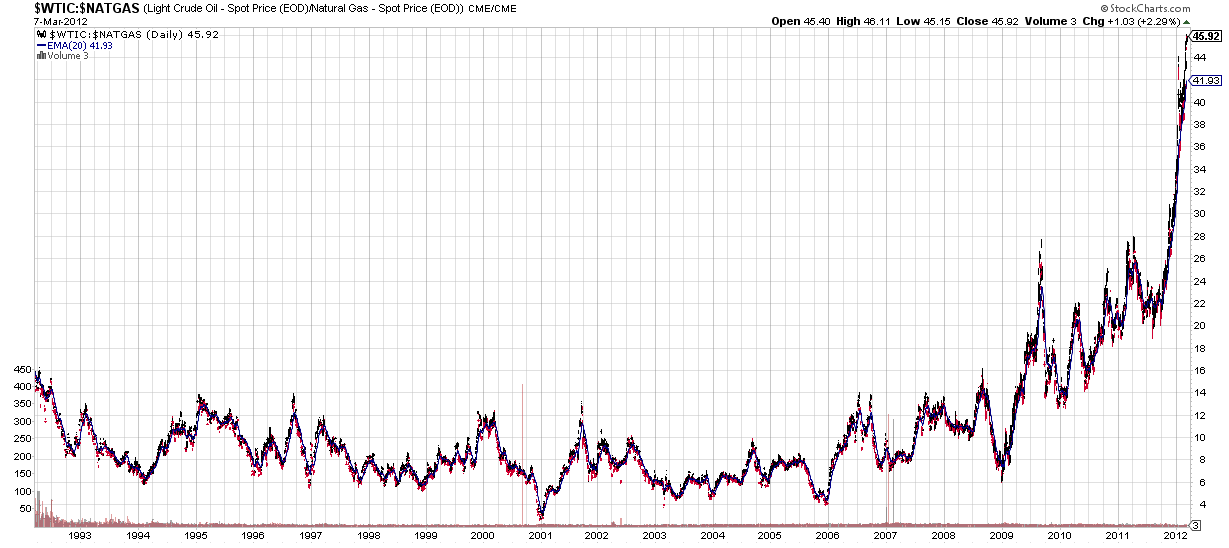
My good friend Ray Conley at Creekstone Capital pointed out the continuing divergence of the market prices of crude oil and natural gas. Being a brilliant math guy and investment guru, Ray knows that statistical aberrations rarely last long and typically are subject to mean reversion. In the case of oil and gas prices, there should be, in the long term, some energy equivalency that keeps their respective prices from continuing on a divergent path. I agree with Ray, in the long term, but I also discussed with him some of the factors that can (not necessarily will) keep the price of oil and natural gas at an "unnaturally" wide spread.


None of this discussion will sound unfamiliar to most hard-core energy guys, but for the sake of other readers, I will just point out a few well known factors driving the oil and gas business right now. I start out by cautioning against the assumption that the price spread shown in the chart above MUST revert to the mean in any short period of time. No doubt there is an argument for energy equivalence: that each commodity is merely used to produce energy and they are therefore "substitutes" from an economist's point of view. But that economist perception ignores some key differences, which are becoming more prevalent.

First of all, to point out the most obvious factor, crude oil is used to make gasoline and diesel and is primarily tied to the transportation needs of the world. There are other marginal uses to produce power and heat (fuel oil) but these are relatively small markets. Natural gas, on the other hand, is not used for transportation fuel - it is used to generate electric power, for residential use (heating, hot water, etc), and as a feedstock for industrial purposes (plastics, chemicals, etc).

About 10 years ago, there were more industries where the two fuels were, at the margin, substitutes for each other. They were/are substitutes mainly in industrial applications where firms can switch their dual-fuel boilers between the two, and for some power producers that could burn either fuel in a power plant.

Historically, that was a big deal when 1) there was less natural gas supply, and 2) industrial use was a bigger part of gas demand. That isn't the case anymore, highlighted by these charts from Nader Masarweh and the California State University - Sacramento Energy Research blog , shown below. Note that there is more total natural gas now (a great deal more), that supply has grown dramatically faster than demand, and that the power sector has become the more important (larger) user. The power sector is a more "sticky" user that doesn't switch fuels based on price, so price divergence between natural gas and crude oil takes on less meaning in today's world. Take a look and then read on below...


Further, I would argue that any fuel switching based on price may have occurred already, based on the divergence of price over the last 2 years. Once all the switchers had done so, the two prices are free to diverge even more so as they would no longer be tied.

And, in the end, crude oil is a transportation fuel that has its own demand and supply curves. And Nat gas is a power fuel that also has its own supply and demand curves. Each will likely work independently to ultimately get the differential to close the existing gap, but not because it MUST, just because crude oil is high and forces are working on demand and supply and because gas is cheap and forces are working there, too. However, those are long term movements. The power sector will continue to increase their use of gas because it is cheap, clean, and plentiful. Many coal plants will be replaced. It could take years before the demand catches up to our new gas supply capacity. Every gas company I talk to has years of wells in inventory they can drill quickly if and when prices rebound, so although low prices are certainly already working marginally on the supply side, we have gotten so good at creating new gas wells at low cost that supply can expand fairly easily if prices start to rise again. I believe it will take a large push on the demand side to really pull gas up hard. That will take years for the long-term balance....or a severe winter where we strain our short-term capacity and drain existing storage.

Another reason many companies continue to produce gas is because they are producing natural gas liquids with it. The value of the liquids stream (propane, ethane, etc) is tied closer to oil prices or to other industrial / chemical demand (as in ethane). These companies will point out that even when their dry gas is just $3.00, the overall value of an mcf of gas includes the liquids that also get extracted, so they really get more like $5 per mcf produced. That is why they keep producing. The same goes for oil drillers in places like the Bakken, they are getting gas as a by-product, and starting to now sell it rather than flare it. A good Bakken well can put off 1-2 million cf of gas a day (2000 mcf). That is the equivalent of a good Marcellus shale gas well with a drill cost of $2mm...and the Bakken guys are getting it for free. With 200 rigs in the Bakken drilling 6 or more wells each a year, that alone would bring on enough gas to replace the 100 gas rigs that might drop out this year.

Meanwhile, companies like Chevron and Exxon continue to increase their production of natural gas, in part because they are learning to improve their shale gas techniques here in the U.S. in order to then transfer their knowledge to international locations where natural gas is very much in need, and selling at far higher prices. The gas market used to be dominated by the independent producers, who ramped up and slowed down drilling very quickly based on price changes. But you can bet the big guys react differently, and far more slowly, to price signals. Another reason gas prices won't revert as quickly in today's world.

So, will the chart revert to the mean? Probably, but it may take time. And the "new mean" may be something very different than the old mean...if you will allow me to play a bit loose with those definitions ;-) And when that happens, I believe we will more likely see crude oil come down, not gas come up. In 2008, I pointed out that we had finally turned the corner on gas production, and my investments started to avoid gas that summer added natural gas puts to take advantage of gas price drops. What I see now in oil is similar - we are creating more new oil supply than ever here in the U.S., and the technology is improving. The difference is that worldwide oil demand is something I continue to see growing, and I believe the new oil right now in the U.S. must replace all the dwindling supplies elsewhere (OPEC and Mexico, North Sea). I think this means we are still in an $85+ oil world, with spikes above that, and that U.S. production will grow, international demand will grow, and the U.S. will become less of an importer, at least in the next 4-5 years. This will dramatically help our trade deficit and I think it bodes quite well for our U.S. economy. The caution I advise, though, is that oil from formations like the Bakken, Eagle Ford, and Niobrara, may be more rare than the natural gas shale plays that have created an oversupply situation. A subject for another day: natural gas is actually being produced out of shale formations, while Bakken oil is actually being produced out of tight formations that are sandwiched between shale formations. Then there is another type of play whereby you "cook" oily shale, which is a different process altogether. Another day, perhaps...

Thursday, January 26, 2012

Honest Data on Tax Rates Paid by Millionaires

OK, this isn't technically an energy topic, but...I am bothered by the way certain politicians mis-use tax data to attack "the wealthy", the latest target being Mitt Romney after his recent tax and income self-disclosures. President Obama recently said that he's not inciting "class warfare", he just wants millionaire's to "pay their fair share" of taxes and doesn't believe guys like Warren Buffet should have a lower tax rate than their secretaries. So, first off, let's recognize that neither Buffet's taxes, nor Romney's, represent the situation for most other wealthy tax-payers, and his secretary's pay isn't likely to bear much resemblance to the "average" middle class worker.

Secondly, let's work with real data, provided by the IRS, the most recent available is from 2009 tax year. Presented at the bottom of this post is a summary of all Federal Income Taxes paid by individuals in the U.S. for 2009 (click on the image to enlarge it so you can read the data). A few observations:

Out of 140.5 Million tax returns filed, there were only 236,883 tax returns in the U.S. with Adjusted Gross Income (before any deductions, exemptions, or credits) in excess of $1,000,000. That is roughly the population of Lincoln Nebraska or Fort Wayne Indiana.

Those 236,883 taxpayers represent just 0.2% (one fifth of one percent) of the taxpaying population, and they paid $177 BILLION of the $865 Billion in taxes collected by the IRS. That is 20.5% of all the taxes paid by individuals. After all deductions and exemptions, 86.2% of their AGI income was taxable, and the $177 Billion in taxes is 24.4% of the $726 Billion they earned. So, while Mitt Romney and Warren Buffet may have pad an effective tax rate of 14%, that is not the case for the average million-plus earning household, which paid at an average rate of 24.4% in 2009.

Go through the table data and notice the rate at which each income level pays taxes. Note things like the people at $1 - $1.5 million paying on average $303,026 to the IRS. Some in politics would have you believe these people get some great tax breaks...but note that same group has taxable income of $111 billion on AGI of $130 billion, so they are paying on 86% of their earnings. The same holds true for all earners above that level until you see a small break at the $10 million and above level (paying an effective tax rate of 22%, due no doubt in part to 15% tax rates on capital gains and certain dividends). So much for tax breaks!! Only 14% of their income gets shielded by any deductions at all.

The middle class, incomes between $50K and $1 million, comprise 33.7% of all tax returns filed, and they paid $627 BILLION in taxes on $5.2 TRILLION dollars in AGI, for an effective tax rate of 12.1%, what appears to be a reasonable rate. The rest of the country (the under $50K in income) pays only 7% of all taxes. Appropriately fair again, in my view...we should not be taxing low wage earners while also supporting with government programs....that is counter-productive. So, 93% of all taxes are paid by earners over $50K, including the highest million-plus earners, while the average tax rate under $50K is 3.5%, after deductions, exemptions, etc.

So, the millionaires are paying at twice the rate (24.4%) of the average middle class worker (12.1%) and seven times the rate of low-income earners. Those 236,883 taxpaying "millionaires" earned an average of $3.1 million in adjusted Gross Income and paid and average of $749,315 in Federal Taxes in 2009.

At a 24.4% effective rate, are the million-plus crowd paying their "fair share"? I would say so. Can they pay more? Maybe, but that isn't the argument made by politicians. If they want to raise taxes on the rich, maybe they should just do so and just call it what it is. This is why President Obama's statements are seen as "class warfare", because they manipulate data to make it sound as if the "rich" are getting away with something. Instead of creating divisiveness among our population, why don't you celebrate the successful, recognize their contribution, and then ask (ok, mandate) for more taxes to be paid. At least they wouldn't feel demonized while also being taxed at high rates.

Last point: given the proposal to increase the effective minimum tax rate to 30% for all income over $1 million, we should ask ourselves what results from that increase. If we take the aggregate taxable income for that group ($626.5 Billion) and increase the rate from the 24.4% they already pay to 30%, that increases total taxes collected (based on 2009 data) from $177 Billion to $218 Billion, a meaningful $40 Billion, or 23% increase in tax collections. For those 236,883 taxpayers, it's another $171,279 in annual taxes on their $3.1 million in AGI.

But wait: $40 Billion is meaningful to the overall individual taxes raised, but what about relative to our annual budget deficit? In fiscal 2010, the U.S. deficit was $1.7 TRILLION dollars (and growing). That is just one year's shortfall of expenses over income. So, $40 billion more would not even knock our annual deficit down to the next round number of $1.6 Trillion. Our problem isn't Federal income, it's Federal spending. Taken to the extreme, you can see that taxing million+ earners at 100% rate (that is, taking their entire $726.9 billion in AGI from them), still wouldn't even cut our annual deficit in half. We cannot tax our way out of this issue based on higher RATES of taxation. We need the entire economy to grow so that the rates we now charge are applied against a larger base. Politicians need to stop fanning the flames of discontent and instead should focus on what we need in this country: jobs, entrepreneurship, and growth.

Labels: , , , , ,

Thursday, October 20, 2011

My Solar output has been staying fairly steady this year compared to 2010. My total solar output in 2010 was 9724 kwh or 26.64 kwh/day on average. Total electric usage on top of the Solar production is about 30 kwh per day in both 2010 and 2011. Given that my marginal rates for electricity above 30 kwh a day are $0.30 to $0.40 a kwh, I am saving about $3500 a year on my electricity bill. Given the net cost of my 7.3 KW system after incentives, my system will pay off in 9 years or less (less under the assumption that marginal rates will rise in future years).

My monthly 2010 solar electricity output looked like this (Jan was just a half month as that was when the system was turned on):


My monthly 2011 solar electricity output looked like this

Tuesday, October 18, 2011

Why I look for 200% Reserve Replacement in an E&P Investment

One of the key things I have always looked for when evaluating an investment in an oil and gas exploration and production (E&P) company, is the ability to economically replace reserves at a rate of over 200% of annual production. That is, for every barrel a company produces, I want to be able to see that the cash flow generated from that production allows them to go find and replace that barrel with two more barrels (2 new barrels replacing one produced = 200% reserve replacement). Doing so with internally generated cash flow allows a company to grow reserves at a reasonable rate, benchmarking around 10%, without raising capital and diluting investors. Why, you may ask, does it take a 200% reserve replacement ratio to grow reserves just 10% annually? Some of you already know the answer, but let's run through an example.

Let me start with the simple example I've shared over the years. I'm simplifying here, but if you are a producer that can find a barrel (Bbl) of oil for $20, produce it for $10 and sell it for $50, you'd be pretty happy. This mathematical model allows for growth in reserves and production and a positive return on capital. First you should recall that an E&P company needs to at least replace each unit of oil it produces with a like unit, otherwise it is just depleting away it's existing asset base. Therefore, the sale of each unit must generate enough excess cash flow to go replace that unit at a cost equal or below that excess cash flow. Let's say your operating metrics look something like this:

1) Drilling and completion cost of your latest well: $6,000,000
2) Size of new reserve from this well: 300,000 Bbls
3) Finding cost per Bbl: $6,000,000 / 300,000 = $20.00 per Bbl
4) Producing life (expected reserve life) of well: 10 years (note that production is not linear, that it comes on at the highest rate it will acheive and will decline over time due to reservoir and pressure depletion)
5) Lease Operating Cost per unit (to flow it from well, maintain well ops, etc): $10.00 per Bbl
6) Sale price per Bbl: $50.00

Therefore, each unit produced will generate cash flow of $50.00 minus $10.00 in lease operating costs, or $40.00 per unit. But now you have depleted your asset base by 1 barrel, so what do you do? You take your $40.00 in cash flow and go invest it into a new drilling program. Since your finding costs are $20.00 per Bbl for a 300,000 Bbl well (assuming here you have a repeatable drilling program), you have the ability to replace your one unit produced with two more. Note that another way to look at it is that the $50 -$10 - $20 finding costs gives you excess of $20 which is "full cycle" free cash flow that allows you to create one new barrel through drilling. So don't be fooled by the $50 - $10 calculation, at first glance you might imagine I was ignoring finding costs. Full Cycle cash flow must be no less than zero to stay flat in reserves, or be positive to grow the company.

This is essentially how you grow the company. In this case above, your company would have the ability to replace reserves on a 2-to-1 basis. But note that producing one actual Bbl doesn't actually get you two because you don't drill wells that are just two Bbls in size. In the absence of borrowing money to drill, you actually need to produce enough of your existing reserve to get the money to drill the next well. In this case, you'd have to produce 150,000 Bbls (half your expected reserves for that well) before you had enough money to drill your next $6MM well…this might take a couple years. The sooner you get your cash back, the sooner you can drill your next well. This is why the first months and first year of production is important.

So let's assume you have 3 million barrel (3MM Bbls) of total reserves at the beginning of the example. You spent $60MM to develop those reserves and have total finding costs of $20.00 per Bbl, which are on your balance sheet as an asset. Your average reserve life is about 10 years, and for simplicity, lets say you are producing 300,000 Bbls each year (this assumes linear production and no decline but is not relevant for the example). You are therefore generating $40/Bbl in cash flow times 300,000 Bbls for $12,000,000 per year. You can use that to drill 2 new wells at $6MM each and come up with another 600,000 Bbls of new reserves. This would be considered a 200% reserve replacement ratio (600,000 Bbls new / 300,000 Bbls produced). But although you replaced 200% of what you produced, your underlying reserve base grew by just 10%:

3,000,000 Bbls beginning reserves
- 300,000 Bbls produced
+ 600,000 Bbls found
= 3,300,000 BBls ending reserves.

In this case, you grew your company's reserve base by 10% annually by achieving a 200% replacement ratio on production.

Of course, if you have a bad year and you spend $12MM in drilling costs and only find 300,000 Bbls of oil you find that your reserves did not grow at all. This is essentially the position many of the larger integrated companies find themselves in: it is very hard to grow reserves once you get to a certain size. The big guys tend to just replace production at a 100% rate, give or take a few percent. Those are not growth companies. Also note that industry-wide finding costs are likely to be in the $15-$20/Bbl range these days and anyone who can improve on that has a big growth advantage.

So…using the FASB 69 supplemental disclosures at the back of every public E&P 10-K:

1) look at annual finding costs (total capital expenditures for drilling / total change in reserves, adjusted for prior period changes)
2) Calculate operational cash flow per barrel produced (Rev - Op Cost) and full-cycle cash flow (Rev - Op Cost - Finding Cost). Compare Op Cash flow to Avg Finding Costs to determine CF per Bbl
3) Look at total reserve replacement (total new reserves / total production)
4) Compare across companies and over rolling 5-year periods (one year isn't a fair assessment period for a growing E&P company) and you will find significant differences that can lead you to asking the right questions about a company's value and ability to grow. Of course, history doesn't predict the future, but positive trends in a company's costs over time should tell you something about the type of reserves the company is chasing and how they are managing their growth. Consistent reserve replacement should be a sign of strength while highly volatile results may be cause for further investigation.

There are many nuances to these calculations which I won't go into here (for example, how to factor in annual reserve adjustments based on price changes and vs. technical reassessments, and the amount of PUD - Proven Undeveloped - reserves that any given company is booking along with their Proven reserves). Again, this example is intended to cover the basics for now. In a later post, I will show an example of the many inputs and calculations.

But now you should start to get pretty excited about a company that has finding costs of $10/Bbl, operating costs of $10/Bbl and is selling oil at $75+ per barrel. You will realize that the ability to grow reserves quickly and economically goes up exponentially when you have all the right cost structures and the ability to repeat drilling success in a given area. For those of you new to this, that is what the industry refers to a "resource" play…an area that has a known resource that can be accessed with existing techniques to result in known well outcomes that cluster around a statistical mean. Hence, the value of a Bakken oil well that I discussed in my earlier post becomes more important when repeatable with known economics. At the end of this year, when 10-Ks come out in April with audited reserve numbers, I believe we will see tremendous reserve growth in the Bakken players, with exceptional finding cost results and industry-leading economics.

Labels: ,

Tuesday, October 04, 2011

What's a Bakken Shale well worth?

In and around energy conferences and among energy guys I hang around with, this question will elicit various responses, partly because there is no "one" Bakken Shale type well. The Bakken play continues to expand and wells vary depending on whether you are asking about the Middle Bakken formation or the lower Three Forks/Sanish formation, and also whether you are talking about the core of Montrail County, ND or the fringe out near the Montana border or into Montana or Saskatchewan. However, for my friends who are not constantly crunching numbers across all these play types, and for the students I work with on understanding the sector, I thought I'd share a very basic model for evaluating the Net Present Value of a single Bakken well. I'll call this a core Middle Bakken well. Using this, with some adjustments when required, you can make conclusions about the value of various companies producing and exploring in the area.

Thanks to the fine people at companies like Continental Resources, Whiting Petroleum, Brigham Exploration, Northern Oil and Gas, Kodiak Oil & Gas, and Triangle Petroleum, as well as the North Dakota Industrial Commission's Oil and Gas website it is fairly easy to find information on the production history of wells drilled in the area.

Companies have discussed in many presentations and press releases wells with initial production rates of 500 barrels of oil per day (BOPD), or 1,000 bopd, or even 2,000-3,000 bopd. With ever changing horizontal drilling and multi-stage frac techniques, the numbers continue to evolve, but with hundreds to thousands of data points now available, we can simulate our own well "type curve" based on what we know of these many existing wells. For those new to the subject, apologies for some missing assumptions, but you should know first off that all these wells follow a pattern of very high initial production with production rates that decline at a decreasing rate. That is, the production per day looks like a falling curve that flattens out over time.

Based on known data in the Bakken region, I will use the following as basic assumptions:

1) Initial production rate of 1800 bopd (ignoring associated natural gas production)
2) Average 30 day production (first month) of 700 bopd
3) First year decline of 55% from initial sustained 30-day rate
4) Decreasing rate of production decline through year 7 to get to an exit rate of about 100 bopd
5) $6 million cost to drill and complete a well
6) Lease Operating expenses and production taxes totaling $20 per barrel to produce
7) Local Oil Price sales realization of $65 per barrel (this takes into account transport costs, etc)
8) Expected life of well: 11-15 years
9) Expected Ultimate Recovery (EUR) of oil: 700,000 barrels per well
10) Discount rate of 10%

The production "Type Curve" looks something like this, which is just a graphic representation of the amount of well produced on a per day basis through time:


Here's a simple spreadsheet you can build to calculate this all yourself, with inputs shown in blue and calculated cells shown in black. Once you have created the average production per day based on annual exit rates, you can calculate the annual production, then apply a net cash flow number (realized oil price less cash costs) to get an annual cash flow, then discount that back for each year (CF / (1 + R) raised to the number of years out). Click on the image below to see it more clearly:


Please note that a few items are simplified here. For example, the cost of production is assumed to be perfectly variable ($20/barrel), yet some production costs are fixed and therefore will be relatively higher on a per barrel basis as the well gets older. It turns out this isn't a huge impact on valuation, however. Also, the "stub end" of production is truncated here for simplicity (the years beyond year 10) but it turns out, again, that these are less important to value than what happens in the first 5 years.

Results and things to note:

A) The NPV of a well is about $15.7 million with IRR of 100%, even at $65 oil
B) The NPV is about $22 per barrel ($15.7 MM NPV/ 700,000 barrels EUR) , indicating what reserves might be worth on a company's books and definitely what they would be worth in an acquisition.
C) Payback is under 12 months (although most companies will conservatively tell you 18 months - this is due to a mix of wells that may produce less than this modeled well)
D) If you change oil price to $85, NPV goes to $25MM per well ($36 per barrel), with 159% IRR and 6-9 month payback on investment.
E) If you change oil price to $45, NPV goes to $6MM per well ($8 per barrel), with 43% IRR and 24-36 month payback on investment.

So now when a company tells you they have 100 core Bakken wells to drill, you can have a thumbnail idea of value: $600MM cost to drill all those wells, with NPV of $2.2 Billion. SO you ask yourself: How many acres does it take to have room for 100 wells? At two wells per 640-acre section, that would require a lease position of 32,000 acres. Not a huge position for most companies. This means a lot of value can be created in a small area. It is important to note that many believe the ultimate development of the Bakken will see 6 wells per section, so there is even more value in good acreage, and even a small area can potentially be very valuable.

So there ya go...fodder for your next cocktail party chat regarding the value of a Bakken shale oil well. Disclaimer: don't take my word for it, read the 10Ks and presentations of all the companies doing the hard work up there.

Friday, May 13, 2011

Hedge Accounting is Distorting the Reality of Oil and Gas Production Earnings

Yes, it has been some time since I have posted anything. What can I say? Life is busy!

OK, I was trained as an undergraduate accounting major, so I understand as well as anyone the desire to match liabilities with the period in which they are incurred. However, the accounting methods for hedging under SFAS 133 (“Accounting for Derivative Instruments and Hedging Activities”) often seem to do more damage than good. Let me explain why this may be a great time to look again at some compelling small-cap exploration and production company stocks. I am writing this entry for the benefit of some of my friends who aren’t experts in oil and gas accounting (neither am I), so pardon the rudimentary lesson, but it is important for investors in this sector to understand.

What some investors see in the most recent quarter (Q1 2011) for small and mid-cap oil and gas producers are large negative net income numbers. Casual observers then ask: “How come these companies aren’t making tons of money in this high oil price environment”. Or: “If they can’t make money at $105 per barrel oil, when can they”? Some of these companies were punished in the stock market after their most recent quarterly results (which unfortunately also came at a point when NYMEX oil prices have been dropping from their highs). So, I will make two very basic statements to start off here:

1) Most of these companies did NOT lose money this quarter, and

2) You have not yet seen $100 per barrel oil hit the income statements of most of these companies

What actually happened is that commodity hedging, and the accounting thereof, has made it harder to see the true earnings of oil and gas producers. Rather than smoothing out earnings, hedge accounting can make earnings significantly more volatile, and moreover, completely misrepresents how an oil and gas company thinks about hedging its risk and managing its budget. Contrary to what we want, in a very volatile oil price market, companies that have locked in fixed prices actually appear MORE volatile than their unhedged comparables.

I will start with the basics, creating an example with my fictitious “Dave’s Oil Company” (DOC). DOC produces 200 barrels of oil a day, and has confidence that production will remain for the next couple of years. So in the latter half of 2010, as oil prices were rising to over $90 per barrel on the NYMEX futures “strip”, DOC decided to hedge some risk by entering into an oil swap with a large derivatives dealer, covering half its production, or 100 barrels per day. A swap basically is a contract that says DOC will pay the other party if oil is above that level and the other party will pay DOC if oil is below that level. That swap allowed DOC to guarantee that it would receive $90 per barrel for 2011 and 2012, regardless of whether oil prices went up or down. If oil goes to $80, the other party pays DOC $10, DOC sells the oil for the market price of $80 and they have received $90 all-in. If oil goes to $100, DOC pays the other party $10, sells its oil for the market rate of $100, and in the end has netted $90 per barrel.

So, DOC has done something great for its investors, its budgeting process, and its lenders and other partners. It has established a future price for a portion of its production and reduced a certain amount of price risk. Since they only hedged half of their production (100 barrels per day of their 200 barrels per day production), they still have some exposure to the upside and the downside, but their volatility is cut in half. If oil drops to $40 per barrel, they will get an average of $65 per barrel (100 barrels at $40 and 100 barrels at $90), and if oil goes to $130, they will receive an average of $110 per barrel (100 barrels at $130 and 100 barrels at $90). In a world where oil might range from $40 to $130, they will only range from $65 to $110.

Now Q1 of 2011 rolls around, and let’s say oil goes to about $110 per barrel by end of quarter. DOC is selling its oil on the open market for $110 and paying the other party in the swap $20. They are netting that expected $90 per barrel for half of their production, and happy to be getting the other half at high market price of $110. Their average realized price after hedging is $100. Total revenue for the quarter would be:

Revenue = 91 days in the quarter X 200 barrels per day X $100 per barrel = $1,820,000

And let’s assume for the moment that they have something like a 20% pre-tax margin.

Pretax Income = Revenue of $1,820,000 X 20% = $364,000

Less a 40% tax rate would give us Net Income of $218,400

With 100,000 shares outstanding, EPS is $2.18

As a shareholder, you’d be happy about your beloved DOC selling oil at $100. Although they gave up some upside with the hedge, everyone sleeps better at night and they can better manage their business.

But WAIT… hedge accounting changes what you see on that income statement. DOC has made a commitment to pay the swap counterparty through 2012. According to the accounting rules, DOC has to recognize this liability. Hedge accounting says DOC must calculate the total value of all those barrels that will be sold at $90. If oil prices on the futures exchange now say that oil will be $110 for the next two years, DOC has to show what that number is. With 365 days in 2012 and 274 days remaining in 2011, it would look like this:

100 barrels per day X 639 days X $20 per barrel = $1,278,000

DOC records a hedge liability on its books (either as a liability or as a change in other comprehensive income in the equity section) and the offsetting entry goes on the income statement. OUCH! They record a “Loss on Derivative Instruments”) above the tax line for $1.278,000. WOW. That wipes out all their net income for the quarter. Heck, it’s almost as big as their revenue line! Now you see this income statement instead:

Revenue: $1,820,000

Pre-Tax LOSS = <$914,000> (that’s the $364,000 “normal” income less the $1,278,000 loss)

After a 40% Tax benefit: Net Income (Loss) of <$548,400>

With 100,000 shares outstanding, EPS is negative <$5.48>

That is the headline number: “Dave’s Oil Company Losses $5.48 per share in First Quarter”

Oh, sure, the company press release then says “adjusting for non-cash hedge accounting losses, the company made $2.18 per share. But the damage is done at the headline level.

More importantly, did the company actually LOSE that $1.2 million? I contend they did not. They have lost the OPPORTUNITY to sell at that higher price in the future, but they made that decision for good reason.

Here’s the next step: When second quarter rolls around, DOC will sell its oil on the open market at the going rate, let’s say it is still high at $110 per barrel. At that point, they record revenue at the market price of $110, and reverse the portion of the liability associated with the current quarter, offset that with a charge against income in the income statement, and the net of it makes it look like they sold the hedged oil at $90 per barrel. That is a good thing…trying to make the income statement look like the reality. However, DOC could just as easily NEVER recorded the liability and would STILL be recording the $90 per barrel currently on an after-hedge basis in Q2. I contend we should use some sort of contingent liability recording in the footnotes of the statements, but that what was done in the old days, and post-Enron, nobody likes this treatment.

But here’s what makes the current method really bad and volatile: If oil prices DROP in Q2 (like they have in 2011), DOC will reverse a large portion of that liability. Let’s say oil goes to $100 across the futures strip, so now DOC will reverse roughly half of what they recorded previously (except that portion associated with the now-past Q2 2011). For simplicity’s sake, let’s say that is roughly $600,000. The Q2 income statement would look like this:

Revenue: $1,820,000

Pre-Tax GAIN = $914,000 (that’s the $364,000 “normal” income plus the $600,000 gain)

After a 40% Tax: Net Income of $548,400

With 100,000 shares outstanding, EPS is $5.48

So, now you see the volatility I spoke of: Instead of recording two consecutive quarters of $2.18 in earnings per share, the company has recorded a $5.48 per share loss followed by a $5.48 per share profit. It still looks, to the unaided eye, that the company has made ZERO profit for the first two quarters combined. And importantly: contrary to what we want, in a very volatile oil price market, companies that have locked in fixed prices for longer periods actually appear MORE volatile than their unhedged comparables. The price volatility “around” the hedge gets recorded every quarter and whipsaws a small company’s recorded profits (but not their cash flow…and that is why you should look at cash flow instead of earnings).

You may also see why I contend many E&P companies did not lose money in Q1 (and please note the vast difference between oil-focused companies and those that produce mainly natural gas). You should also see why I said you haven’t yet seen the impact of $100 oil on many companies. Many of them are living with older hedges that have kept them averaging more like $75 to $80 in Q1. As the older hedges come to fruition and are replaced by higher-priced barrels, you will ultimately see higher average oil prices on income statements. Maybe I will post a separate blog on that subject…

In any case, if oil prices stay just under $100 through Q2, you will see large reversals of those liabilities and losses from Q1, resulting in non-cash gains to be recorded in Q2. The headline numbers will look much more positive in Q2 (July and August reporting dates). There may be some good deals to be had right now in oil-focused small cap E&Ps with large, attractive, hedge positions.

But don’t be fooled: hedge accounting is making it hard to look at headlines and bottom lines. As always, value and truth is found in between the lines.

Monday, November 02, 2009

Energy companies pay the most taxes amongst the S&P500

Total taxes paid for 2008 by the largest corporations in the U.S. (as represented by the S&P500) are shown in the table below. The Energy companies in the S&P500 earned 18.5% of the revenues in the group but paid 29.8% of the actual cash taxes paid in 2008. Financial firms paid less in aggregate but paid the highest rate compared to revenues (presumably due to fewer deductions such as depreciation, as the Financial sector is less hard-asset capital intensive). Energy companies paid at a rate twice that of many other industries. When this year is over, 2009 will likely be the same story, with energy companies being the largest corporate taxpayers in the country. The myth of big tax breaks for energy companies needs to be dispelled.


Source: Capital IQ, Company documents, SEC filings

Labels: , ,

Wednesday, June 17, 2009

The latest data from BP's Statistical Review of World Energy

I know it has been a long while since I've posted, but things have been busy! Right now I am working on an analysis of European unconventional oil and gas opportunities, but I am also slogging through the latest data provided by BP in their annual "Statistical Review of World Energy 2009". This annual compilation of data and analysis is an industry standard and for those who haven't ever viewed this rich data source, it's time you check it out. Much of the macro data essential to understanding the fundamental energy supply and demand structure of the world is available here, including traditional and alternative sources of energy. Thanks to the team at BP, as they do an amazing job with their report each year, and they provide great tools for charting, manipulating, and downloading data. If you don't want to download and manipulate data yourself, the Energy Charting Tool is very user friendly. The more you get into it, the more you appreciate it.

I'll be back soon with some thoughts on European natural gas...

Labels: , ,

Tuesday, April 29, 2008

Energy Policy. First Step: Admit You Have a Problem

I would like to propose two prerequisites for any political candidate:
#1) take at least one Economics Course
#2) Visit an AA meeting

As we continue to suffer the ridiculous rhetoric and glaring lack of economic understanding from our Presidential candidates on how to solve our energy issues, I am reminded that most alcoholics know how you start to fix an addiction. You first admit you have a problem. Our politicians haven't done so yet.

Instead, they want to blame everyone else: OPEC isn't producing enough; Big Oil is greedy, speculators are causing the problem; Detroit won't make the right cars; taxes are too low on energy producers (I love the stupidity of that one).

Back in the 1970's, my connection to the energy business was a modest one. I was a teenager working as a gas station attendant in California (before the days of "self-serve"). I have distinct memories of turning customers away during the days of gas rationing, which in California meant consumers could only buy gas every other day, based upon the last number (odd or even) of your license plate. I was 16 years old and I had the power to refuse service to people. Boy, did they hate that. People begged for just a gallon so they could get to work, school, etc. It was a terribly misguided energy policy, and it caused people to hoard gas, fill up more often, and even steal gas (people learned to siphon from other cars, and this led to the invention of something previously unseen: a locking gas cap).

That bad policy did nothing to help people during a shortage, and in fact probably exacerbated it, but what it did accomplish was that people started to admit they had a problem: an addiction to something with finite supply. At the same time, something very different than today was being discussed by our leaders... they actually said that oil would likely stay high in price and get worse over time. With oil at $30, they said it could go to $100! From our President (Jimmy Carter got on TV in his cardigan sweater and asked us to turn down our thermostats), to OPEC leaders, to academics, and everyone on the street, we heard a consistent song: Oil had spiked in price and was GOING HIGHER. This consistent message convinced us all we should change our behavior. We started buying smaller cars and paying attention to things like gas mileage. The Honda Civic had the most bland commercial on TV: it promised (and delivered) over 40 MPG.

Contrast this to today. Every day for the last 5 years you have been told that high oil prices are the fault of one group or another (but never the consumer). When oil hit $30/Bbl, you were told to just wait, because it would come back down. At $50, you were again told it was just speculators, that it would get better. At $70: same thing, and again at $100, and now at $118 or so. You are being fed the line that the politicians can fix it by calling Big Oil in front of Congress, by suspending gas taxes, by taxing oil companies for "excess profits". Not only is this ridiculous, but it allows the consumer to avoid coming to the conclusion that our HABITS MUST CHANGE. Instead....if you just wait one more week, one more month, one more year, they tell you it will all be fixed for you.

It won't. Certainly not by the proposals being floated by certain politicians.

In a commodity market where demand grows in linear fashion, but supply comes in discreet stair-step chunks (and only with massive investment over a long time), you get periods where PRICE is the only way the market finds balance. Price is the arbiter of who gets what, when. Price determines highest and best use.

In this type of market, there are two solutions to reduce price, an ONLY two solutions. One is to increase supply, and the other is to decrease demand. High price is the only signal to participants that causes them to either use less or produce more. If the price signal is not strong enough for either side of the equation, it continues to rise until one side finally moves. Right now, the oil companies are drilling at a historic pace, so they have responded to the price signals. But oil isn't discovered and brought to market the next day. It can take years. So, it is now the consumer who has not yet taken the price signal (both here and abroad). And instead of encouraging the consumer to do so, politicos are suggesting that we actually MUTE the signal by lowering gas taxes in the short run. And then they compound this by suggesting we increase taxes on producers of oil, which would lead to less drilling and production.

These misguided policies only serve to make the problem worse by decreasing supply and keeping demand high. Given that they have it exactly backwards (and I really don't think they are that stupid), I can only come to the conclusion that they don't really mean any of this, but it sells in an election year. The problem is that some people actually believe them, and I would hate to see us repeat the mistakes of the past on an even grander scale today.

So I say please to Ms. Clinton and Mr. McCain:
#1) take at least one Economics Course
#2) Visit an AA meeting

Labels: , , , , ,

Tuesday, March 25, 2008

NYT: On Carbon, Tax and Don’t Spend

Carbon taxation makes much more sense than a cap and trade system, which just shifts the problem instead of removing it. One doesn't have to look farther than the EU ETS to see the miasma of problems cap and trade faces. The primary reason cap and trade gets political support is because it appeases the lobbyists, who realize that carbon legislation is imminent and therefore support the scheme that protects their balance sheets as much as possible. As Ms. Prasad suggests, tax the CO2 producers, earmark the money specifically for clean energy programs, and be done with it.

---

The New York Times

March 25, 2008
Op-Ed Contributor
On Carbon, Tax and Don’t Spend
By MONICA PRASAD

Evanston, Ill.

EVERYONE seems to be talking about a carbon tax. It’s probably the most glamorous — and certainly the most unlikely — use of the tax code since Al Capone got hooked for tax evasion.

The idea is that polluters should pay for the environmental damage they cause. Slap a tax on carbon, the theory goes, and you will get fewer carbon emissions, more revenue for government and energy independence, all at the same time. No wonder people from both sides of the political divide have come out in support of it.

But a carbon tax isn’t a new idea. Denmark, Finland, Norway and Sweden have had carbon taxes in place since the 1990s, but the tax has not led to large declines in emissions in most of these countries — in the case of Norway, emissions have actually increased by 43 percent per capita. An economist might say this is fine; as long as the cost of the environmental damage is being internalized, the tax is working — and emissions might have been even higher without the tax. But what environmentalist would be happy with a 43 percent increase in emissions?

The one country in which carbon taxes have led to a large decrease in emissions is Denmark, whose per capita carbon dioxide emissions were nearly 15 percent lower in 2005 than in 1990. And Denmark accomplished this while posting a remarkably strong economic record and without relying on nuclear power.

What did Denmark do right? There are many elements to its success, but taken together, the insight they provide is that if reducing emissions is the goal, then a carbon tax is a tax you want to impose but never collect.

This is a hard lesson to learn. The very thought of new tax revenue has a way of changing the priorities of the most hard-headed politicians — even Genghis Khan learned to be peaceful, the story goes, when he saw how much more rewarding it was to tax peasants than to kill them. But if we want lower emissions, the goal of a carbon tax is to prompt producers to change their behavior, not to allow them to continue polluting while handing over cash to the government.

How do you get them to change? First, you prevent policy makers from turning the tax into a cash cow. Carbon tax discussions always seem to devolve into gleeful suggestions for ways to spend the revenue. Reduce the income tax? Give the money to low-income consumers? Use it to pay for health care? Everyone seems to forget that the amount of revenue is directly tied to the amount of pollution that is still going on.

Denmark avoids the temptation to maximize the tax revenue by giving the proceeds back to industry, earmarking much of it to subsidize environmental innovation. Danish firms are pushed away from carbon and pulled into environmental innovation, and the country’s economy isn’t put at a competitive disadvantage. So this is lesson No. 1 from Denmark.

The second lesson is that the carbon tax worked in Denmark because it was easy for Danish firms to switch to cleaner fuels. Danish policy makers made huge investments in renewable energy and subsidized environmental innovation. Denmark back then was more reliant on coal than the other three countries were (but not more so than the United States is today), so when the tax gave companies a reason to leave coal and the investments in renewable energy gave them an easy way to do so, they switched. The key was providing easy substitutes.

The next president of the United States seems sure to be more committed to environmental policy than the current president is, and a carbon tax is high on everyone’s list of options. Indeed, a carbon tax has been promoted almost as a panacea — just pop in the economic incentives and watch them work their magic. But unless steps are taken to lock the tax revenue away from policymakers and invest in substitutes, a carbon tax could lead to more revenue rather than to less pollution.

An increase in gasoline taxes — the first instinct of many American policy makers when the idea of a carbon tax comes up — would likewise be the wrong policy for the United States. Higher gas taxes would raise revenue but do little to curb pollution.

Instead, if we want to reduce carbon emissions, then we should follow Denmark’s example: tax the industrial emission of carbon and return the revenue to industry through subsidies for research and investment in alternative energy sources, cleaner-burning fuel, carbon-capture technologies and other environmental innovations.

Monica Prasad, an assistant professor of sociology and a faculty fellow at the Institute for Policy Research at Northwestern University, is the author of “The Politics of Free Markets.”


Copyright 2008 The New York Times Company